
Blown Away - Issue 4
This is the fourth in a series of bi-annual newsletters sharing updates on the progress, team, and unexpected discoveries from this research programme.
New Zealand faces ongoing risks from insects and pathogens blown here on the wind—an often-overlooked gap in our biosecurity defences, and one likely to grow with climate change. The Protecting Aotearoa from Wind-Dispersed Pests programme is addressing this challenge over the next three years by improving knowledge of in-transit pest survival, updating wind models, and tracking how and when organisms move through the air. The goal: a predictive warning system to help us respond faster and more effectively.
Testing the limits of moth flight
Mark Jermy and Toni Withers
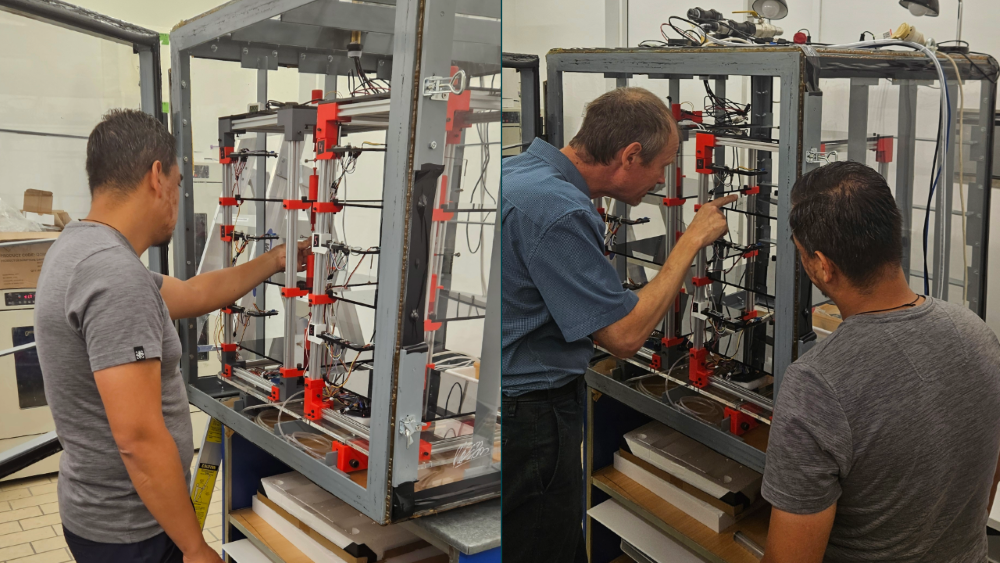
A new laboratory has recently been established in the Mechanical Engineering Department at the University of Canterbury to study how far pest moths can fly under different environmental conditions.
Traditionally, the department’s wind tunnels have been used to test the aerodynamics of drones, aircraft wings and other engineering designs. Now, researchers Matthew Donnelly, Lorenzo Orlando and Dr Mark Jermy have added a specialised environmental flight chamber designed specifically for insects.
Inside this chamber, Fall Armyworm moths can fly while researchers carefully control air pressure, temperature, humidity, and even day–night light cycles. This allows the team to recreate the kinds of atmospheric conditions moths experience when travelling long distances at altitude.
The first experiments are already underway by Bioeconomy Science Institute Maiangi Taiao entomologist Dr Samuel Aguilar. Current trials are testing air pressure equivalent to conditions about 1,500 metres above sea level. Early results suggest that moths may not be able to sustain flight for as long under these higher-altitude conditions.
Over the next six months, the team will investigate how low air pressure, cold temperatures and other environmental stresses affect the moths’ endurance — critical factors in determining whether they can survive wind-borne journeys across the Tasman Sea.
In mid-February, Master’s student William Falconer Beach will begin a new set of experiments examining another important challenge faced during migration: the impact of raindrops on moths in flight.
Together, these studies will help build a clearer picture of the physical limits of long-distance moth migration and improve our ability to anticipate future incursions into Aotearoa.
Quantifying how successful moths are at flying across the Tasman
Mark Jermy and Toni Withers
In our last newsletter, we introduced the team investigating how environmental conditions affect the survival of fungal rust spores as they travel through the air. In this edition, we turn our attention to another group of airborne travellers — pest moths — and the research helping us understand how they reach Aotearoa.
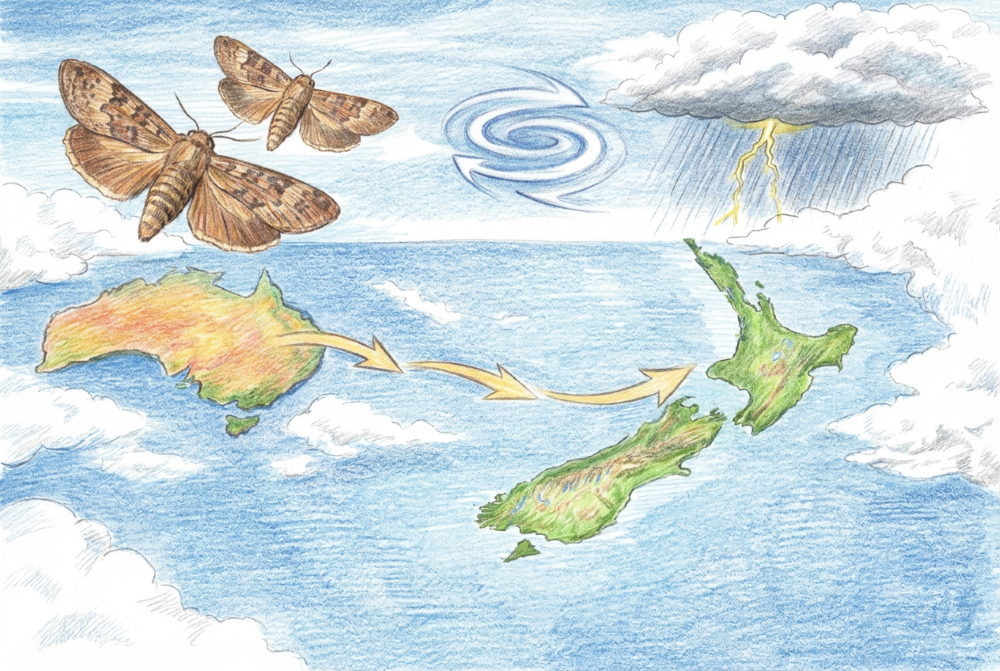
Some moth species can travel remarkable distances by riding high-altitude winds. For those crossing the Tasman Sea, the journey is long and challenging. Temperature, wind speed and direction, air pressure, and rainfall all influence whether a moth survives the trip and successfully makes landfall in New Zealand. To better understand this process, our researchers are combining computer modelling with laboratory experiments to study how moths fly and how conditions such as low air pressure and rain affect them while airborne.
One species of particular interest is the Fall Armyworm (Spodoptera frugiperda). This invasive moth has been established in New Zealand since 2022 and is believed to have arrived with the assistance of prevailing winds. Over the past decade, it has spread rapidly across several continents, largely by taking advantage of atmospheric wind systems.
Modelling the limits of flight
We are delighted to have welcomed Dr Patrick Scheunemann to the team during his sabbatical from South Westphalia University of Applied Sciences in Germany. Working with Mark Jermy, Patrick has adapted a well-known flight energetics model — originally developed to understand how birds fly — to suit the biology of the Fall Armyworm.
The model incorporates the moth’s wing size and shape, body mass, aerodynamic drag, and stored energy reserves. Using this information, it predicts how fast the moth can fly and how long it can sustain flight. The results are striking: without favourable winds, a Fall Armyworm would not be able to complete even half of the Tasman crossing.
The next phase of the research will explore how moth behaviour influences their chances of success. For example, do they select particular flight altitudes? Do they attempt to compensate for crosswinds? And how much does encountering rain reduce their survival prospects?
By improving our understanding of how pest moths travel through the atmosphere, this research strengthens our ability to anticipate future incursions and better protect Aotearoa’s ecosystems and food production systems.
Forecasting air bridges to Aotearoa
Marwan Katurji, Anjali Thomas and Toni Withers
A key goal of the ASaP model is to predict when weather patterns are likely to carry unwanted pests or pathogens to Aotearoa on the wind. These long-distance dispersal events depend heavily on large-scale synoptic weather systems (the broad pressure patterns that shape wind direction and strength) across the Tasman Sea.
Over the past six months, Dr Marwan Katurji from the University of Canterbury, School of Earth and Environment, has been applying a synoptic classification system developed with Dr Anjali Thomas to interpret week-ahead forecasts of wind and weather patterns. Each week, he provides forecasts to the Research Area 4 surveillance team highlighting the likelihood of “connecting winds” — sustained airflows that could transport insects and pathogens from Australia to New Zealand.
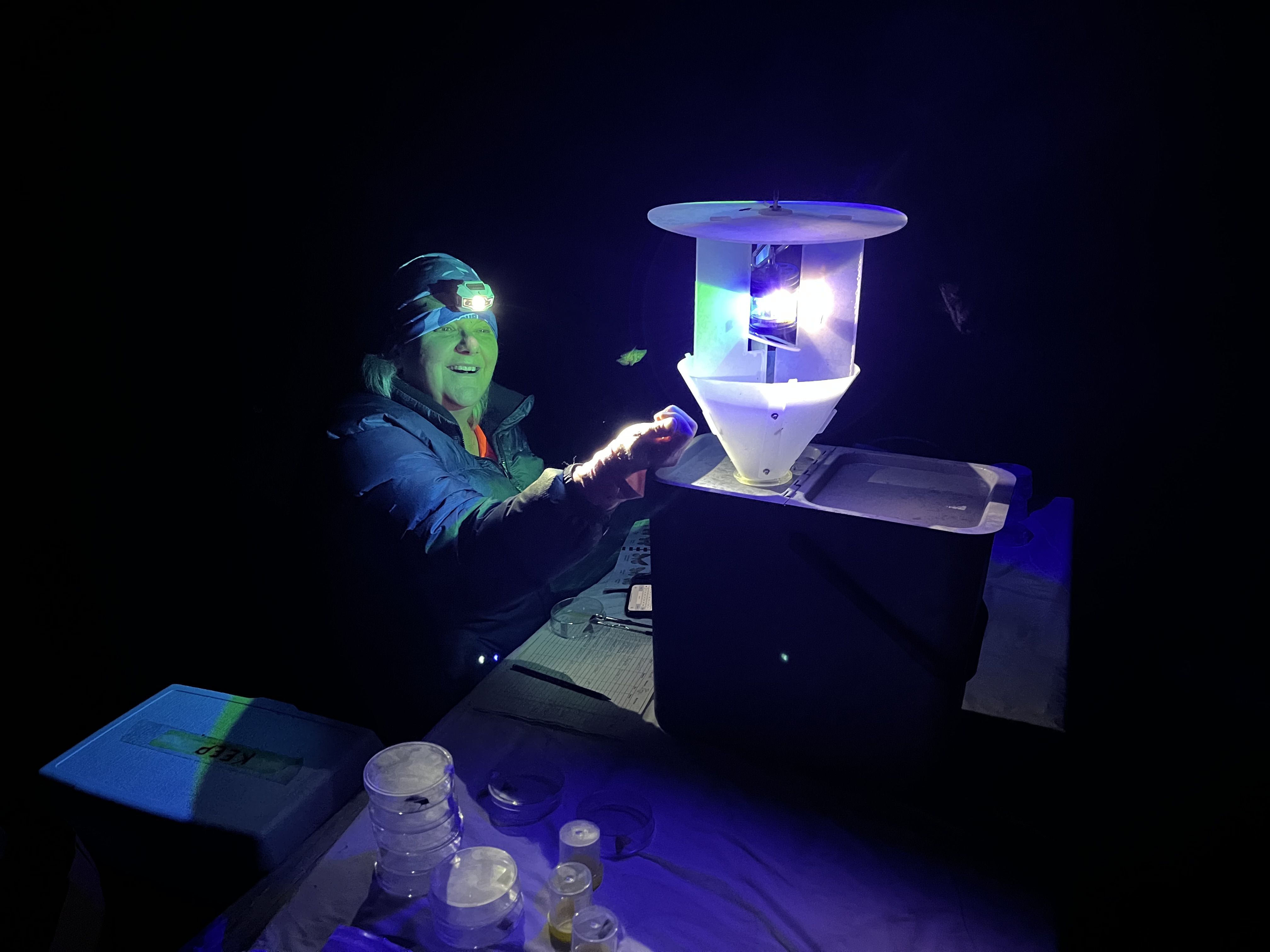
These forecasts guide our surveillance efforts. When conditions look favourable for a trans-Tasman crossing, staff and volunteers prepare to collect air samples and deploy light traps to detect arriving moths and pathogens.
Spring is typically an active season for connecting wind events, and 2025 proved no exception.
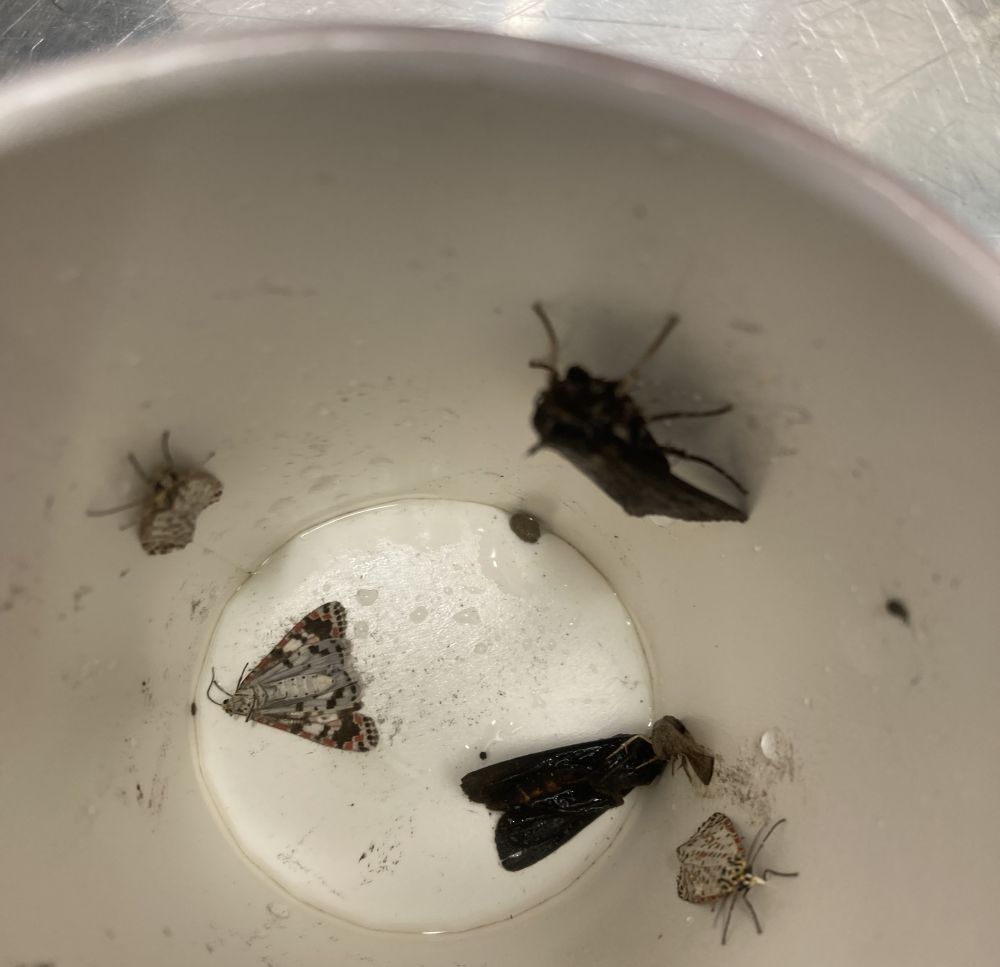
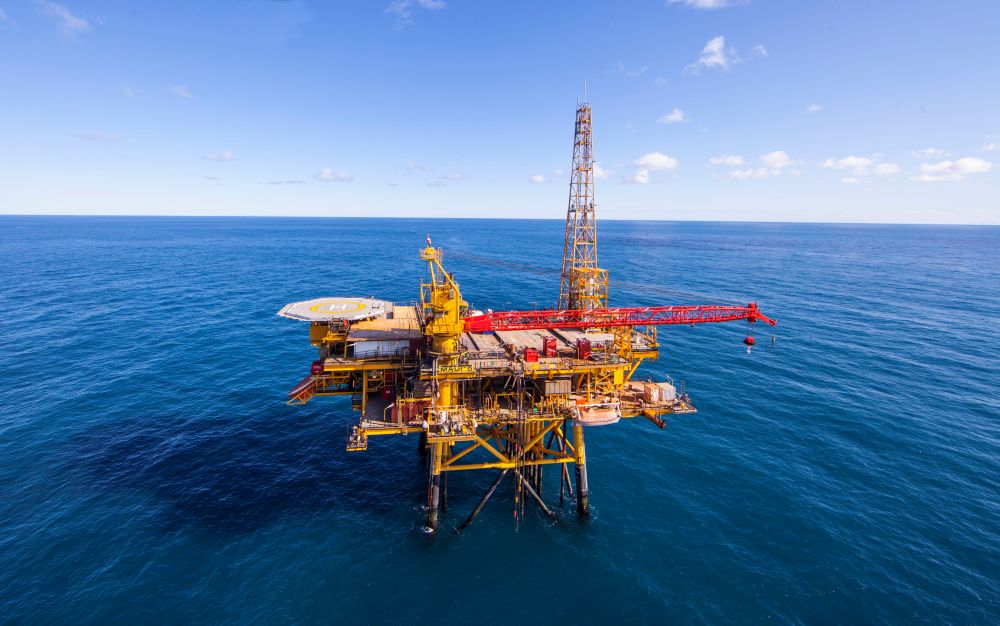
On 6 October 2025, Marwan issued a forecast noting that “Monday and Tuesday look like a classical weather pattern for a sustained air bridge” from New South Wales, Australia. The prediction proved accurate. That Monday night, two large migratory cutworm moths (Noctuidae) were intercepted — one on an offshore oil platform and another at lights in New Plymouth — followed by another the next evening.
Later that same week, on 9 October, another forecast warned of a strong air bridge at 900 metres altitude connecting the same air mass towards Taranaki. Over the following weekend (10–11 October), volunteers monitoring OMV’s Māui B platform intercepted a dozen large moths, including heliotrope moths (Erebidae) and additional cutworm moths (Noctuidae). Reports of similar moths from across the North Island on iNaturalist.nz suggested that some had successfully reached land.
Toni Withers, who leads moth surveillance in RA4, recently acknowledged the extraordinary contribution of citizen scientists in a Sci-Gest podcast, highlighting the critical role volunteers play in detecting these arrivals.
A celebrity arrival: the Bogong moth
The following week brought another notable interception: Bogong moths (Agrotis infusa) were recorded in New Plymouth on 15 October and in Auckland on 18 October.
Bogong moths hold near-celebrity status in Australia. Once extraordinarily abundant, their populations declined by around 99% after 2019, largely due to drought and agricultural pressures. Each spring, billions of adults migrate up to 1,000 kilometres from south-eastern Australia to aestivate in the cool caves of the Snowy Mountains, escaping the summer heat.
Remarkably, Bogong moths are known to use the Earth’s magnetic field, along with visual cues in the night sky, to navigate during migration. While most head for the Snowy Mountains, some appear to have taken advantage of strong westerly winds and extended their journey across the Tasman Sea to New Zealand.
Trans-Tasman flights by Bogong moths have been recorded previously, but the 2025 interceptions generated renewed interest in Australia and provided further evidence of how atmospheric “air bridges” can connect our ecosystems.
Together, these events demonstrate the power of combining atmospheric forecasting with on-the-ground surveillance. By identifying when connecting winds are likely, we can better anticipate potential incursions — strengthening New Zealand’s biosecurity preparedness.
Why is Milad spending so much time with balloons? The vertical coupling research area's secret weapons
Milad Behravesh and Marwan Katurji
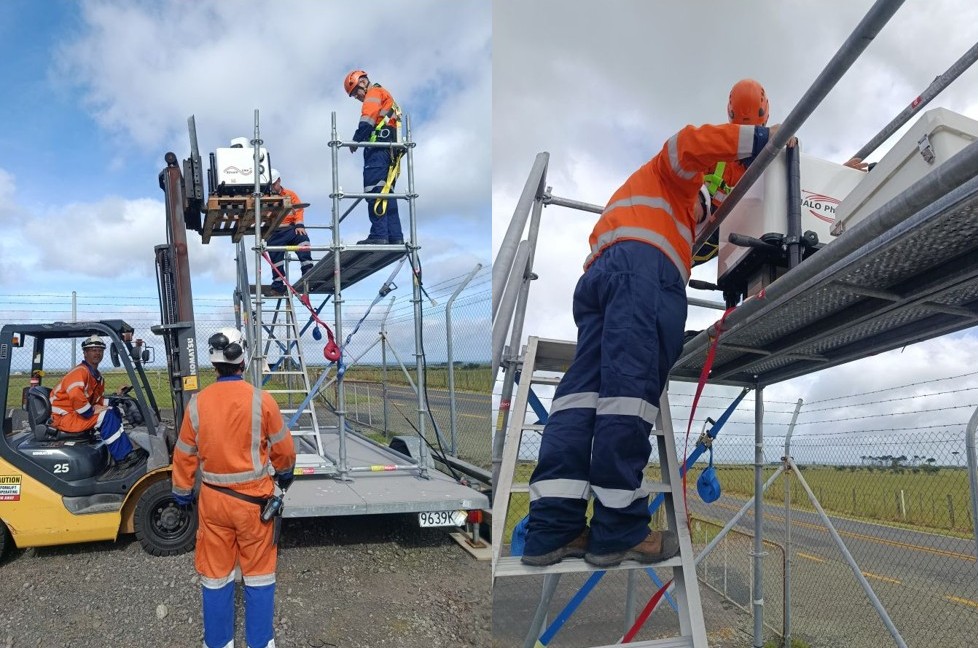
Over the past few months, we have been developing a detailed “vertical view” of the atmosphere above a coastal monitoring site in Taranaki. By combining weather balloons (radiosondes) with a Halo Photonics Doppler wind LiDAR system, we are uncovering how vertical atmospheric movements influence the deposition of pests on our shores.
Radiosondes provide high-resolution measurements of temperature, humidity, wind speed, and wind direction up to 5 kilometres above the surface. These profiles allow us to identify the height and stability of the atmospheric boundary layer (ABL) — the lowest part of the atmosphere that is directly influenced by the Earth’s surface. Depending on conditions, the ABL can be turbulent and convective, relatively neutral, or strongly stable. Understanding these stability regimes is critical. Sharp changes in temperature and wind speed with height — known as gradients and wind shear — define “entrainment zones.” These are the layers where airborne organisms may be lifted into faster-moving air currents over Australia or deposited when air masses descend toward New Zealand.
In the image from the December 2025 launch you can clearly see distinct gradients separate the turbulent surface layer from the more stable free atmosphere above — key regions controlling whether pests remain aloft or are brought down to land.
While radiosondes provide detailed snapshots, the Doppler wind LiDAR delivers continuous, 24-hour monitoring of wind speeds, vertical air motion, and turbulence in the lowest 2 kilometres of the atmosphere. This allows us to track daily cycles in the boundary layer — its growth during daytime heating and convection, and its collapse overnight as the surface cools. At a coastal site like Taranaki, this is especially important. Land–sea breezes can create zones where airflows decouple and reorganise, precisely where windborne insects transition from ocean transit to potential landfall.
The LiDAR’s reinstallation in late 2025 marked the beginning of a long-term dataset that forms the foundation of Milad Behravesh’s PhD project investigating boundary layer dynamics during airbridge events. The next step is integration. We will combine these observational datasets with high-resolution Weather Research and Forecasting (WRF) simulations across the Tasman Sea, and Lagrangian dispersion modelling driven by observed wind profiles. This will allow us to quantify how atmospheric structure influences how long particles remain airborne, how quickly they descend, and how likely they are to be deposited under different large-scale weather patterns.
Together, these insights will strengthen our ability to forecast invasion risk — improving preparedness for Aotearoa’s forests, farms, and diverse ecosystems.
Acknowledgement
The team acknowledges OMV Energy for allowing us to install the Halo Photonics Doppler wind LiDAR at their onshore production station and for all the help they provided during the installation process.
Meet the team
This time we are shining the spotlight on the researchers involved in Research Area 2: Vertical Coupling.

Dr Jiawei Zhang
Bioeconomy Science Institute Maiangi Taiao, Christchurch
Research Area 1.2 co-leader
Jiawei is an atmospheric scientist within the Fire and Atmospheric Sciences team at the Bioeconomy Science Institute, based in Christchurch. He has a strong background in atmospheric science, with research interests in micrometeorology, atmospheric-fire interaction, air pollution, and cloud microphysics. His work focused on the small-scale atmospheric turbulence over the complex terrain and how the role it plays in wildfire, seed dispersal and other high impact events. He is quite excited to expand his research area to the transport of aerial invaders within the atmospheric boundary layer.

Jessica Kerr
Bioeconomy Science Institute Maiangi Taiao, Christchurch
Research Area 1.2 co-leader
Jess is a forest entomologist who specializes in active surveillance and biosecurity technology development. Her research activities and interests are spread across multiple disciplines, including entomology, pest management and wildfire fire research. Jess leads the Pest Risk and Eradication programme of research at the Bioeconomy Science Institute that aims to avoid future long-term pest management costs in urban, production and natural environments. The project does this through the development of new knowledge and tools in pathway risk assessment, surveillance and early detection, new models and tools for eradication and community co-design of technology.

Dr Marwan Katurji
School of Earth and Environment, University of Canterbury, Christchurch
Research Area 1.2 co-leader & PhD student supervisor
Marwan is an atmospheric scientist who specializes in surface-atmosphere interactions, and has undertaken numerous research projects throughout New Zealand, the United States and Antarctica. His research interests are around modelling, simulating, measuring and analysing atmospheric boundary layer phenomena, and he uses advanced field measurement and numerical modelling techniques to tackle research objectives. Dr. Marwan Katurji is particularly interested in Coherent Turbulent Structures (CTS) within the first 1km of our atmosphere above ground level (also called the atmospheric boundary-layer). CTS are a unique fabric of turbulence that controls the spatial variability of temperature, moisture, and atmospheric particles across our landscape.

Dr Peyman Zawar-Reza
School of Earth and Environment, University of Canterbury
Research Area 1.2 collaborator
Peyman is primarily a highly interdisciplinary Data Scientist interested in understanding complex dynamical systems, by analysing their high frequency outputs/data, from which we might be able to infer their intrinsic mechanisms. Most of my research to date has involved studying the role of turbulence in the atmosphere, but recent advances in neurosciences has highlighted the fact the brain signals, can also be studied using methods applied to turbulent motion in fluids.

Dr. Milad Behravesh
School of Earth and Environment, University of Canterbury, Christchurch
Research Area 1.2 PhD candidate
Milad is an atmospheric scientist pursuing his PhD on boundary layer dynamics controlling windborne pest transport across the Tasman Sea. Using Doppler LiDAR and radiosonde observations from OMV's Taranaki site, accompanied by atmospheric modelling simulations, his research quantifies coastal turbulence processes determining invasion risk for Aotearoa's forests and agriculture.

Dr. Anjali Thomas
School of Earth and Environment, University of Canterbury, Christchurch
Research Area 1.2 – Post doctoral fellow
Anjali is an atmospheric scientist whose research explores how planetary- and synoptic-scale circulation patterns shape climate variability and high-impact weather, particularly extreme rainfall and temperatures. Her work also examines Australia–New Zealand weather pathways, using flow patterns across the Tasman Sea to understand atmospheric transport and connectivity, with relevance for environmental risk and resilience. She uses reanalysis datasets alongside statistical, machine-learning, and spatio-temporal approaches to link weather regimes to extremes and climate change impacts.

Dr. Nikolas Aksamit
Department of Mathematics and Statistics, UiT - The Arctic University of Norway, Tromsø, Norway
Research Area 1.2 – collaborator
Nik’s research focuses on implementing innovations in applied mathematics and developing novel measurements techniques to better understand coherent structures relevant for atmosphere-surface coupling processes. Nik is collaborating with the team to develop novel ways investigating atmospheric transport processes in the atmospheric boundary layer.